

Sunday, April 20, 2014
An explosion of life

Wednesday, March 26, 2014
Bye Japan!

70 days in Japan. 25 days cycling across it and 45 days working in Tokyo were more than enough, perhaps too much. Unlike that wonderful feeling of wanting to come back over and over again that countries like Mongolia or Indonesia left in me during this last year, the more time I spent in Japan the more I felt the need to leave. This by no means mean having had a bad time but mostly not having been able to achieve a deep connection with the country and its culture.
Japanese style extravangaza
During these 70 days in the most technologically developed country of the planet, we've seen many amazing things. At some level, after some time of being here, one feels that the Japanese are really beyond everything. Let me explain it. The reality of this country is so so different than that of the rest of the planet, especially the one in the third world, that at some point it almost feels like science fiction. The activities, the problems, the preoccupations that seem to occupy the mind of the Japanese are so radically different from those that me and the people around me lived with that I sometimes feel like I'm in Disneyland. Tokyo never stops and life happens at full speed. The famous crossing of Shibuya,, sees 100.000 people crossing it per hour during rush hour. With its squandering of light and yelling advertisements, it is the icon that sums up the frantic pace of life in Tokyo. In each of its corners, when the traffic light is green for the cars, people start accumulating like drops of rain in a water tank, when the traffic light turns red it bursts, and people run like ants going in every direction as when one steps on an anthill.
Friday, March 21, 2014
One year on the road

Highway to the future
After leaving Kyoto, we finally entered the last stretch to Tokyo. It was a road in the future towards the future. We decided to cycle the 550 km along route 1, the road that connects some of the biggest industrial zones in Japan. We could've certainly chosen a quieter road along the countryside with a little bit more nature, but we had a commitment to be in Tokyo at a certain time and we hadn't neither many days left nor the will to continue much longer.
Japan is a cutting edge country, it seems to be a couple of years ahead from the other rich countries and light years ahead from the rest of the planet, but only technologically speaking. In terms of human touch it lags light years behind most of the economically poor countries, which one really starts yearning with every step on the pedal in this country. Respect, honesty and politeness are values that abound here, and that is very positive, but indifference and apathy also abound as well. With the exception of our friends in Osaka and that really unique man we had met in Fukuoka the first day, we haven't really had any true connection with any single person. We are pretty much two ignored human beings that pass mostly unnoticed riding along the roads of the future. It is fascinating and hideous at the same time.
After leaving Kyoto, we finally entered the last stretch to Tokyo. It was a road in the future towards the future. We decided to cycle the 550 km along route 1, the road that connects some of the biggest industrial zones in Japan. We could've certainly chosen a quieter road along the countryside with a little bit more nature, but we had a commitment to be in Tokyo at a certain time and we hadn't neither many days left nor the will to continue much longer.
Japan is a cutting edge country, it seems to be a couple of years ahead from the other rich countries and light years ahead from the rest of the planet, but only technologically speaking. In terms of human touch it lags light years behind most of the economically poor countries, which one really starts yearning with every step on the pedal in this country. Respect, honesty and politeness are values that abound here, and that is very positive, but indifference and apathy also abound as well. With the exception of our friends in Osaka and that really unique man we had met in Fukuoka the first day, we haven't really had any true connection with any single person. We are pretty much two ignored human beings that pass mostly unnoticed riding along the roads of the future. It is fascinating and hideous at the same time.
Sunday, February 23, 2014
A little bit of nature

Despite the virtually infinite urban continuum along Japanese routes, there are some places where there is relatively a higher proportion of nature. Needless to say it is never an unspoiled nature - one simply doesn't come to Japan in search of adventure because there isn't any - but it is nature in the end and, on the island of Shikoku in autumn, it is especially beautiful. After taking nearly a dozen boats and ferries during this last year, some passing through traditionally stormy waters, it was almost surprising that there had never been strong tides. More surprising still, would be that when crossing to Misaki, in the peninsula's turquoise waters of Sadamisaki, we arrived yellow in color and almost puking. What a tide out of Saganoseki! In just 10 minutes it forced me to lie on the floor and it made of the remaining 60 the closest thing to being inside an operating washing machine. It was not until the next day that the remaining headache was definitely gone. My surname is Marino (it means “sailor” in Spanish) but it seems that such surname didn’t endowed me with any extra maritime skills.
Illusion of perfection

Getting
to Japan is like leaving the present and take a leap into the future,
at least technologically (I hope!). Even coming from Korea, which is
on the right track to become "the future" soon, the impact is remarkable. Just to think
that only two months ago we were cycling across the steppe and the desert of
Mongolia feeling that we were centuries back, disembarking in Fukuoka
feels as divorced from the present as the Mongolian experience. From the Chinese frantic chaos to the extreme Japanese order, the gap is also radical. At
first glance, everything in Japan seems perfect and is dazzling
wherever you look at. However, with each passing day, this
hyper-ultra developed giant reveals very crude imperfections for
anyone who's willing to take a deeper look without getting carried away by all that
glitters.
Monday, February 3, 2014
A few videos of the year
While we take a two weeks breaks in India with my mom, I invite you to watch the following compilation of videos from the past year, the first year of this trip.
The a summary of the whole year in only 7+minutes
One year cycling in 7 minutes from Nicolas Marino on Vimeo.
Indonesia, riding across the jungle. Part I (revamped version from the extended one)
The a summary of the whole year in only 7+minutes
One year cycling in 7 minutes from Nicolas Marino on Vimeo.
Indonesia, riding across the jungle. Part I (revamped version from the extended one)
Sunday, February 2, 2014
The longest bicycle path in the world

Korea seems fully aware of the problems that come with such an excess of technology and a population of workaholics. To try to compensate for these new "bad habits", the result of a mega-project of engineering that involved reconfiguring the course of the four major rivers of the country, included with it the design of several bike paths that connect the whole country from north to south from east to west. In this way, they are not only making exhaustive use of hydroelectric power but also giving people an incentive to go cycling and stay outdoors, providing them with the necessary space to do it in a safe, comfortable and professional way.
Aside from the main "four rivers bike path" that links Incheon with Busan along 700 km, the number of new bike-path is increasing year by year, connecting different regions and cities.
Many are currently under construction and the final goal is to connect the whole country through a network of bike paths, allowing cyclists to move freely, staying away from the dangers of motorized traffic. This not only solves the stress of the cyclists but also that one of the drivers, increasing overall safety significantly. As if it weren't enough, the government made sure to design the path in a way that would connect the major tourist attractions of the country. Quite an advanced way of thinking.
Aside from the main "four rivers bike path" that links Incheon with Busan along 700 km, the number of new bike-path is increasing year by year, connecting different regions and cities.
Many are currently under construction and the final goal is to connect the whole country through a network of bike paths, allowing cyclists to move freely, staying away from the dangers of motorized traffic. This not only solves the stress of the cyclists but also that one of the drivers, increasing overall safety significantly. As if it weren't enough, the government made sure to design the path in a way that would connect the major tourist attractions of the country. Quite an advanced way of thinking.
Sunday, January 26, 2014
Little giant
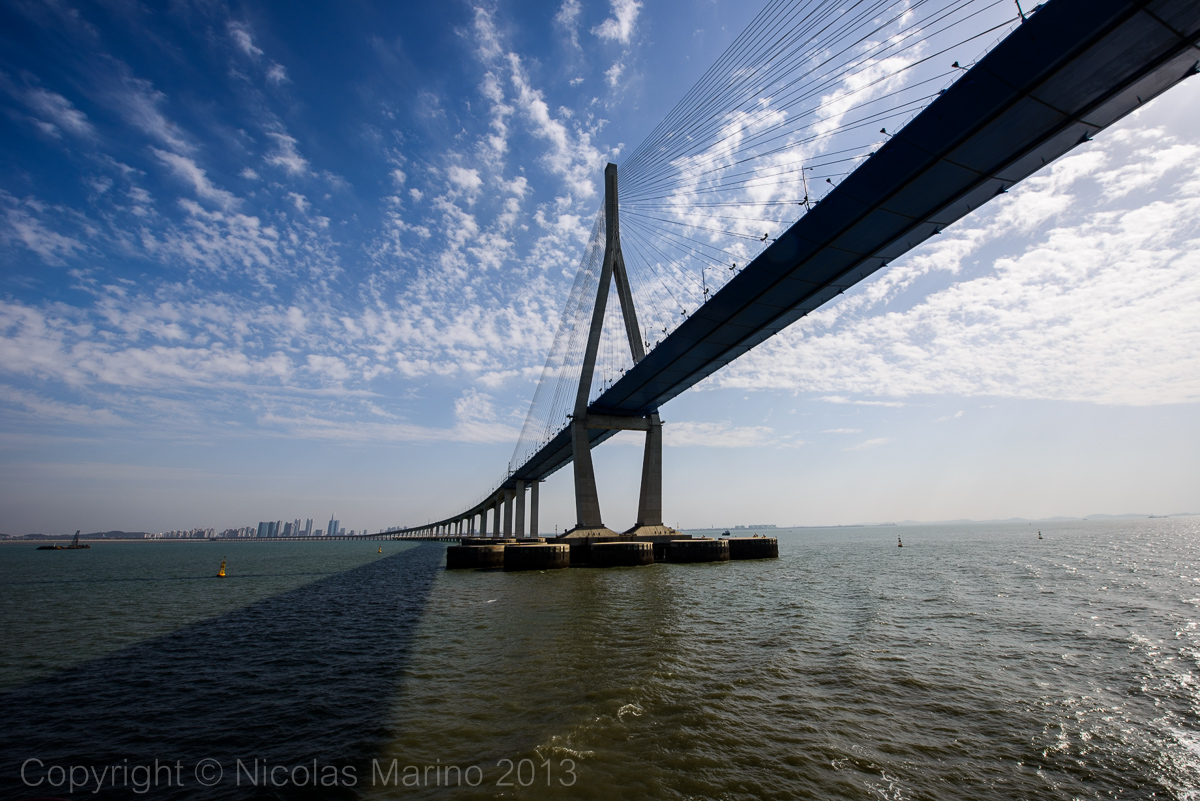
South Korea is the country number 50 that I visit, and after almost a year of pedaling mainly through remote regions of Asia , arriving in Korea was like an abrupt jump into the future. That leap forward took away the adventurous routes loaded with adrenaline that constantly fed us for so many months. All that temporarily came to an end. Adventure would be reduced to zero, zilch, nada and the extreme roads and rigorous weather would all be left behind. How to survive on a small budget in these technology congested jungles, extremely reduced space and exorbitant prices would become the new challenge. The enjoyment would not be the beautiful tingling of the adrenaline running through the veins but the bedazzlement facing a world so technologically advanced that it is someimtes incomprehensible.
Sunday, January 19, 2014
Dharma. My new bicycle.
We crossed into China with a voracious appetite. It was not the hunger as much as the necessity we had to eat well, to eat delicious food and nothing better than being back in China to accomplish this. You pay the price though, of exchanging a fairy tale dream land for being back at the factory of the planet and the return to it feels like the most brutal punch back to the crude reality. It was inevitable since sooner or later we would have to leave the tale anyway.
The poisoned earth
Already in the final stage of our crossing of the desert, on the way to Zamyn-Udd one could already the change in the horizon. Ahead of us, we were able to see the Chinese horizon and what used to be an immaculate blue sky vanished into a murky grey. Once in China, the remaining 300 km of Gobi desert were devoid of any attractive whatsoever. A flat terrain, infinite, dull, full of huge high voltage power lines towers, a massive increase in the traffic which was loud, fast and annoying and now with the added hindrance of a very strong headwind that was incredibly hard to tolerate. However, the worst would come in the final 300 km before Beijing riding across the scary province of Hebei 河北.

The incredibly high price that China has to pay for insisting in keeping a level of growth that is simply unsustainable, unsustainble for them and unsustainable for the whole planet, is nothing but outrageous.
Tuesday, January 14, 2014
Mongolia in the heart
Having cycled across Mongolia meant having made a long-time dream come true. 55 days that felt like leaving the time and space in which one is used to live in. It is probably true that you must have felt some romanticism in all of what I have written about this country, but it's just that the beauty of Mongolia takes you out of your own orbit and invites you to romanticize. Its landscapes of smooth shapes and slow paced "precarious" life pacify the mind and evoke a feeling of magic inside. It is true that these are images of its brief summer. Soon after we leave the country, temperatures will plummet down to -20C and by the end of December they will stabilize between -37 and -40C (when speaking, Mongols unconsciously omit the "-") and a windchill of much lower ones. Even with its extreme weather, I suspect that even spending a winter here should be an intense experience which I'll try to make happen some time in the future.
There are many beautiful countries in the world, or better said, all countries are beautiful or have something beautiful in and/or about them, but there are countries that apart from being beautiful they are special. In my perception, when I'm in this kind of places I can sense an extra quality that separates them from the rest. Until today I have trouble describing what that quality is and I certainly have no definition for it, but it's like a series of phenomena that happen in the same space at the same time invoking a physically and mentally positive body reaction inside oneself, a sort of mix of joy and inner-peace. I have come to feel this truly powerful sensation in my several years of traveling across the Tibetan plateau, and I have happily felt it once again here in Mongolia. It is not by coincidence, I think, that both Tibetans and Mongolians live both in very extreme regions of the planet and carry out ways of living and have spiritual beliefs that are very similar. Mongolian nomads are by all means extraordinary people and that's to say little about them. Their affection has gotten very deep inside us and we have lived some of the most truly special moments in some of the most unreal and remote places that I have ever been to. I think I will never leave Mongolia because it is very deep inside me and has grown on me, in both my heart and the sheep smell that seems impossible to wash away. The series of photos at the top of this post are a very brief summary of the infinite images that were recorded in my retina.
Stardust

Sunday, January 12, 2014
Lake after lake

Friday, January 3, 2014
Problems and no problems

Tuesday, November 19, 2013
Nomadic life

Mongolia is a massive and sparsely populated country. With an area of 1.564.115 km2 and just 2,800,000 inhabitants, the density of the country is reduced to less than 2 persons per km2. However, in real terms, the density is much lower, since 1,300,000 of the total population of the country, live in Ulaanbaatar, the capital. The result is a country where nature in its pure state is experienced almost all times but, except for the desert regions, is not an empty nature but one that is inhabited sparingly. Half of the country's population is nomadic and semi-nomadic, the latter being those who practice nomadism seasonally, settling in villages to spend the winter. Nomads and their lifestyle is something that has intrigued and captivated me from a very early age (it is no coincidence the kind of life I live) and it is one of the main reasons why I wanted to cycle in this country so much
Subscribe to:
Posts (Atom)